
How to Look Up Arapahoe County Jail Population Data
The primary official source for Arapahoe County jail population data is the Arapahoe County Sheriff's Office. ACSO publishes annual reports on its public affairs page at files.arapahoeco.gov. Annual reports from 2015, 2019, and 2021 are available and contain detention operations summaries, workload statistics, and service-area context. The Sheriff's Office does not appear to publish a live daily population dashboard on a publicly accessible web page, so current real-time census data is not available through a public portal the way some larger county jails provide it. For current population figures, call the Detention Facility directly at 720-874-3500.
The Bureau of Justice Statistics maintains the most complete national jail census data. Its annual Jail Inmates reports at bjs.ojp.gov track total jail populations, average daily populations, admission counts, pretrial shares, and demographic distributions for county and city jails across the United States. BJS data runs about one to two years behind real time, but it covers all reporting jurisdictions. The Vera Institute of Justice publishes county-level incarceration trend data at incarcerationtrends.vera.org, which can show Arapahoe County historical jail admissions and population estimates over time. The Prison Policy Initiative maintains a Colorado state profile at prisonpolicy.org that breaks down who is incarcerated statewide and under what legal status. These sources, used together with ACSO annual reports, form the best available picture of Arapahoe County jail population trends.
Arapahoe County Jail Capacity Overview
Arapahoe County operates one county detention facility. The Arapahoe County Detention Facility is located at 7375 South Potomac Street, Centennial, CO 80112, adjacent to the Arapahoe County Justice Center on South Potomac Street. The facility is open 24 hours a day, seven days a week. The main public phone number is 720-874-3500. The facility is the only county jail operated by ACSO; there is no second county detention site. Rated capacity for the Arapahoe County Detention Facility was not published in the specific official pages reviewed during research. The table below reflects what is confirmed from official sources; the capacity field is marked as not located rather than left blank with a placeholder number.
| Facility | Address | Rated Capacity | Phone |
|---|---|---|---|
| Arapahoe County Detention Facility | 7375 S. Potomac St., Centennial, CO 80112 | Not located in current official sources | 720-874-3500 |
Note: Rated bed capacity and current population figures are not displayed on the ACSO public website. Contact the Detention Facility directly or request data through the Arapahoe County Sheriff's Office for current figures. The Colorado Open Records Act (CORA) may allow a formal request for aggregate population statistics held by the Sheriff as a public agency.
Average Daily Population
Average daily population, or ADP, is the standard measure for how full a county jail runs over time. It is calculated by dividing total inmate-days in a year by 365. A specific current ADP figure for the Arapahoe County Detention Facility was not located in the official annual reports or public web pages reviewed for this project. The ACSO annual reports for 2015, 2019, and 2021 cover detention operations context but did not include a published ADP number in the portions available.
For Colorado statewide context, BJS reported that Colorado county jails held an average daily population in the mid-to-high range among Mountain West states in recent census years. National ADP for all local jails was approximately 665,000 in 2022 per BJS, compared to a peak of about 780,000 in 2008. The long-term trend nationally shows a decline from the late 2000s peak, followed by a partial rebound after COVID-era population drops. Arapahoe County is a large, suburban metro county with a significant pretrial population and a wide range of charge types, which typically produces ADPs above state rural-county norms. Vera's county trends tool can provide Arapahoe-specific annual estimates if you search the county directly at incarcerationtrends.vera.org.
Operational data from the 2015 ACSO annual report gives indirect scale: more than one million meals were served at the Detention Facility that year, and nearly 18,000 inmates were supplied with uniforms. Those figures suggest a substantial daily population, though a precise ADP number was not stated in the report text.
Demographic Breakdown
Specific demographic breakdowns for the Arapahoe County Detention Facility by sex, race, age, or citizenship were not published in the official ACSO annual reports or public web pages reviewed for this project. The research gap is noted honestly. The table below shows national jail demographic distributions from BJS as context; Arapahoe-specific figures are marked accordingly.
| Group | National Jail Average (BJS) | Arapahoe County Specific |
|---|---|---|
| Male | Approx. 85% | Not located in official sources |
| Female | Approx. 15% | Not located in official sources |
| White (non-Hispanic) | Approx. 47% | Not located in official sources |
| Black (non-Hispanic) | Approx. 34% | Not located in official sources |
| Hispanic/Latino | Approx. 15% | Not located in official sources |
| Other | Approx. 4% | Not located in official sources |
BJS national figures come from the Census of Jails and annual Jail Inmates at Midyear publications. They represent averages across thousands of local facilities and do not reflect Arapahoe County's specific population. Colorado, as a Western state with a significant Hispanic population, may have a different distribution than the national average. The Prison Policy Initiative's Colorado profile at prisonpolicy.org/profiles/CO.html provides state-level breakdowns that are closer in geographic context to Arapahoe County than national averages. ACSO annual reports or a direct data request to the Sheriff are the only verified paths to Arapahoe-specific demographic figures.
The screenshot below is from the Bureau of Justice Statistics home page, which publishes annual national jail census data including demographic breakdowns that provide national context for county-level comparisons.
The Bureau of Justice Statistics publishes annual Jail Inmates reports covering national jail demographics, pretrial rates, and population trends by jurisdiction size and region.
BJS data is the standard benchmark for comparing local jail populations to state and national rates, including the rate-per-100,000-residents metric used in policy analysis and journalism.
Pretrial vs. Sentenced Population
The pretrial share of a county jail is one of the most important indicators of how the local justice system operates. People held pretrial have not been convicted; they are awaiting a hearing, trial, or resolution of charges. A high pretrial share often reflects tight bail conditions, long case timelines, or both. A specific pretrial-to-sentenced ratio for the Arapahoe County Detention Facility was not located in official sources reviewed for this project. The pretrial/sentenced split table below uses national BJS figures for context; the Arapahoe-specific column notes the data gap.
| Status | National Average (BJS) | Arapahoe County Specific |
|---|---|---|
| Pretrial (unconvicted) | Approx. 65-70% | Not located in official sources |
| Sentenced / convicted | Approx. 30-35% | Not located in official sources |
Nationally, BJS data shows that roughly two-thirds of people in county jails on any given day are unconvicted and held pretrial. That share has grown over the past two decades as prison populations declined while pretrial jail populations stayed high. Colorado's pretrial context includes the statutory money-bond framework under C.R.S. 16-4-102, which the ACSO bond-rights notice references directly. The statute gives detained persons the right to have bond conditions set and requires the Sheriff to release within six hours after all required bond payments are received. Arapahoe County also holds weekend bond hearings on Saturdays at 1:30 p.m. via Webex, which helps move pretrial decisions faster than jurisdictions with weekday-only hearings. These structural features affect how long pretrial individuals remain in custody, and by extension, the pretrial share of the daily population.
Misdemeanor vs. Felony Population
Arapahoe County's two-tier court structure splits criminal cases between County Court and District Court. County Court handles misdemeanors, traffic infractions, and the initial advisement and bond setting for felony charges before cases move up to District Court. District Court handles all felony trials, sentencing, and post-conviction matters. People booked for felony charges typically appear first in County Court for bond hearings and preliminary hearings, then move to District Court for trial and disposition. During the pretrial period, regardless of whether the charge is a misdemeanor or felony, the person may be held at the Arapahoe County Detention Facility.
A specific felony-to-misdemeanor breakdown of the Arapahoe jail population was not published in the ACSO annual reports reviewed. Nationally, BJS data shows that felony-charged individuals make up the majority of people held in county jails on any given day, even though misdemeanor admissions are more frequent across the year. The two metrics differ: admissions count how many people enter the jail (misdemeanors produce high short-term turnover), while average daily population reflects who stays longer (felony-charged individuals awaiting trial or serving longer sentences). DA Amy Padden has stated a policy goal of pursuing alternatives to incarceration for non-violent offenders, which may affect how lower-level misdemeanor and non-violent felony cases are resolved over her term, which runs through January 2029. For current data on the felony-misdemeanor split, the ACSO Detention Services Bureau is the appropriate contact.
Mental Health and Medical Population
Mental health and medical care are a central operational cost and policy challenge for county jails. People booked into local jails arrive with a wide range of medical and psychiatric needs, and jails must provide constitutionally adequate care regardless of the charge or length of stay. Specific numbers on the share of Arapahoe County detainees receiving mental health services, psychiatric medication, or medical treatment were not published in the official ACSO pages reviewed. This is a common gap: most county jails do not publish clinical census data publicly, and medical records are restricted by privacy law.
DA Amy Padden's stated priorities include "better ways to address mental health and substance abuse in the criminal justice system." That policy direction is consistent with the broader shift in Colorado and nationally toward diversion, treatment courts, and alternatives to incarceration for people whose offenses are driven by behavioral health conditions. The 18th Judicial District has historically used problem-solving and treatment-oriented approaches. Nationally, BJS data consistently shows that jails hold a disproportionately high share of individuals with mental illness compared to the general population, and the share receiving mental health treatment in jail has grown. State-level data from the Prison Policy Initiative's Colorado profile at prisonpolicy.org/profiles/CO.html provides further context on how Colorado's incarcerated population compares to national norms on health-related indicators.
The screenshot below is from the Prison Policy Initiative's Colorado profile page, which breaks down Colorado's incarcerated population across jail, prison, and supervision categories and provides data on who is held under what legal status.
The Prison Policy Initiative Colorado profile provides a breakdown of Colorado's total incarcerated population, including county jail, state prison, federal custody, and community supervision figures relevant to Arapahoe County context.
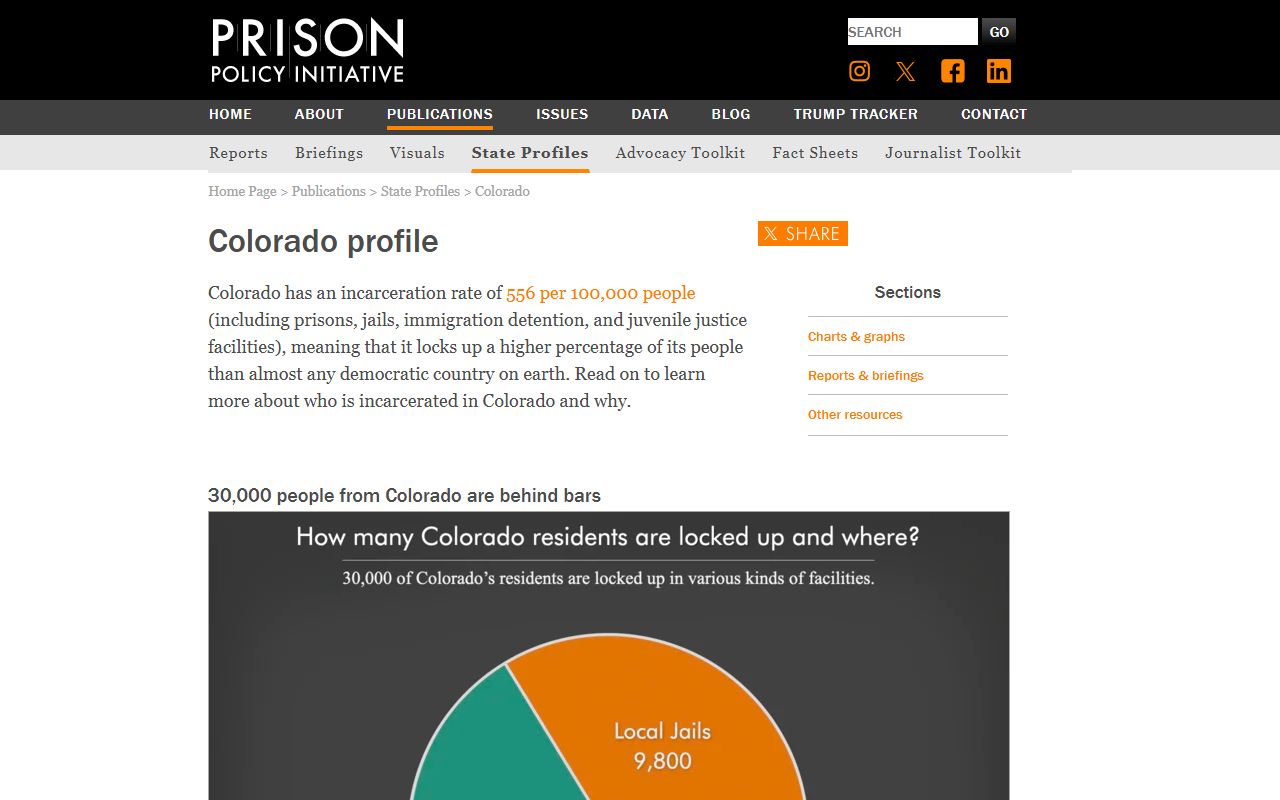
Colorado's overall incarceration rate, visible in the Prison Policy Initiative profile, reflects both county jail population and state prison population, helping situate Arapahoe County jail data within the state picture.
National and State Context
Comparing local jail rates to state and national benchmarks requires a rate-per-100,000-residents calculation, which controls for population size. Arapahoe County had an estimated population of approximately 675,000 to 700,000 residents in recent years, making it one of Colorado's largest counties. A specific daily population count for the Arapahoe County Detention Facility was not located in official current sources, so a confirmed county rate cannot be calculated and published here. The comparison block below uses verified state and national figures from BJS; the county row notes the data gap clearly.
| Level | Jail Population per 100,000 Residents | Source |
|---|---|---|
| Arapahoe County | Not calculated (daily population count not located) | ACSO / data gap |
| Colorado (state average) | Approx. 130-160 per 100,000 (varies by year) | BJS / Vera Institute |
| National average | Approx. 190-210 per 100,000 (recent BJS years) | BJS Jail Inmates at Midyear |
Colorado's jail rate per 100,000 residents has generally run below the national average in recent BJS reports. That is partly a function of Colorado's relatively urban population, its use of citation-and-release for some offense categories, and criminal justice policy choices made at the legislative and prosecutorial level. The national rate peaked around 2008 and has declined since, though the pace of decline varies significantly by state and county. Large suburban counties like Arapahoe often have lower rates than rural counties because they have access to more pretrial services, more capacity to set conditions of release, and more DA-office resources to handle cases quickly. However, large urban-adjacent counties also see significant felony case volumes from major cities in the metro area, which pushes populations up. Vera's county-level trends tool can show how Arapahoe has moved relative to Colorado's overall trajectory.
It is also important to distinguish jail from prison when reading any incarceration statistic. County jails like the Arapahoe County Detention Facility hold people who are awaiting trial, serving sentences of one year or less, or awaiting transfer to state prison. People serving sentences longer than one year go to the Colorado Department of Corrections. The CDOC offender search at doc.state.co.us/oss/ covers state prison population, which is counted separately from county jail data. Federal inmates at a Bureau of Prisons facility are counted separately again. These three systems do not overlap in official census counts, and conflating them produces inflated or misleading incarceration figures.
Population Trends Over Time
The ACSO has published annual reports covering at least 2015, 2019, and 2021. These reports provide operational snapshots that give indirect trend context even where specific population counts are not stated. The 2015 report described the Detention Facility as operating like a "small city," with over one million meals served, nearly 18,000 inmates supplied with uniforms, 260 laundry exchanges in housing units, and 93,261 pieces of inmate mail processed that year. Those operational figures imply a substantial and sustained daily population. The 2019 report noted ACSO served a population of 644,000 people across nearly 900 square miles. By the time of the 2021 report, the service population had grown, with ACSO now described as serving approximately 864 square miles.
Nationally, county jail populations dropped sharply in 2020 as courts slowed and jurisdictions released people during the COVID-19 pandemic. BJS documented this dip clearly in its midyear reports. Most jurisdictions saw partial rebounds in 2021 and 2022 as courts reopened, but populations did not return uniformly to pre-2020 levels. Arapahoe County, like other large Colorado counties, likely followed a similar pattern, but published local data confirming exact figures was not located during this research pass.
The screenshot below is from the 2021 ACSO Annual Report, which is one of the official sources providing detention operations context for Arapahoe County population trend analysis.
The 2021 ACSO Annual Report is published by the Arapahoe County Sheriff's Office and covers detention operations, bureau structure, and service-area context for the county.

The 2021 report is one of several ACSO annual publications that provide detention-services context and help establish a multi-year operational baseline for the Arapahoe County Detention Facility.
The 2019 ACSO Annual Report is an earlier annual report covering the period before COVID-era population changes, making it a useful baseline for understanding pre-pandemic detention operations in Arapahoe County.

The 2019 report is particularly useful for trend analysis because it captures the pre-pandemic period when national jail populations were still near their post-peak plateau, providing a comparison point for more recent operational data.
For a longer historical view, the Vera Institute's county incarceration trends database at incarcerationtrends.vera.org draws on federal data sources and can show Arapahoe County's jail admission and population trajectory across multiple decades. Vera data allows comparisons between Arapahoe and neighboring Colorado counties, and between Arapahoe and national suburban-county averages.
Searching for Arapahoe County Inmate Records by Name
This page covers aggregate jail population data, not individual inmate records. For name-based searches of the live jail roster, the booking history of a specific person, or current custody and bond status at the Arapahoe County Detention Facility, see the Arapahoe County inmate records page. You can also call the Detention Facility directly at 720-874-3500 or visit the official ACSO inmate information pages to access the lookup tool.
Where the Data Comes From
The data and context on this page draw from four types of sources. First, the Arapahoe County Sheriff's Office annual reports, available at files.arapahoeco.gov, are the primary local official source and the only verified county-specific population-related documents located in this research pass. Second, the Bureau of Justice Statistics at bjs.ojp.gov publishes the national Census of Jails and the annual Jail Inmates at Midyear series, which are the standard government benchmarks for all local jail comparisons. Third, the Vera Institute of Justice at incarcerationtrends.vera.org provides county-level trend data derived from federal sources with added geographic detail. Fourth, the Prison Policy Initiative's Colorado profile at prisonpolicy.org/profiles/CO.html provides statewide incarceration context disaggregated by facility type and legal status.
Where Arapahoe-specific numbers were not located, this page says so plainly rather than substituting estimated or derived figures. The rated capacity of the Arapahoe County Detention Facility, the current daily population, the pretrial share, the demographic breakdown, and the felony-misdemeanor split are all noted as data gaps as of the research date. These figures may be available through a direct public records request to the Arapahoe County Sheriff's Office under the Colorado Open Records Act, C.R.S. 24-72-201 et seq. For individual inmate records and name-based roster searches, use the Arapahoe County inmate records page. For information on recently released individuals, see the released inmates page. For background on criminal cases that may have preceded a jail booking, see Arapahoe County criminal records. General questions about the court system and what records are available are answered at the FAQ.
Note: Vera Institute and Prison Policy Initiative are non-government sources. They are included because they aggregate federal BJS data and provide the county-level and state-level comparisons that official BJS publications do not always present in an accessible format. Neither source is affiliated with Arapahoe County or ACSO.