
What Probate Covers in Arapahoe County
Probate is the legal process a court uses to confirm a will, settle an estate, or appoint someone to manage a person's affairs when they can no longer do so. In Arapahoe County, that work happens inside the Arapahoe District Court. Colorado does not have a freestanding probate court in Arapahoe County; Denver is the only Colorado county with a separate Probate Court. Every other county, including Arapahoe, routes probate matters through District Court under Title 15 of the Colorado Revised Statutes, the Colorado Probate Code.
The District Court handles several distinct but related matter types. Estate administration covers the formal process of proving a will and distributing assets. Guardianship establishes legal responsibility over a person who cannot make their own decisions, whether an adult with a disability or a minor whose parents cannot act. Conservatorship is similar but focuses on managing money and property rather than personal care. The court also handles trust matters, mental health proceedings, and protective-order cases involving vulnerable adults. Each type of case generates its own set of filings, orders, and records, all of which are maintained by the Arapahoe Clerk of Court.
The Colorado Judicial Branch publishes an official probate information document specific to Arapahoe County. That document, available at coloradojudicial.gov/media/6961, covers case types, procedures, and court contacts. It is the official starting point for anyone new to Arapahoe probate matters.
Probate Terms Defined
Probate filings use specific legal vocabulary that can be confusing if you are new to the process. The terms below appear in almost every Arapahoe County probate case file.
- Testator
- The person who made and signed a will. When a testator dies, the will they left is submitted to the court as part of the estate case. An Arapahoe District Court probate case filed to administer a will opens with the will and a statement about the testator's death and domicile.
- Personal Representative
- The individual or institution appointed by the court to administer an estate. This person is sometimes called an executor when named in a will, or an administrator when appointed by the court without a will. The personal representative inventories assets, pays creditors, files required notices, and distributes property under court supervision.
- Intestate
- Dying without a valid will. When a person dies intestate, Colorado's statutory succession rules under Title 15 determine who inherits. The court still opens a probate case and appoints a personal representative, but the distribution follows state law rather than the decedent's written wishes.
- Guardian
- A person appointed by the court to make personal decisions for someone who lacks the capacity to make those decisions independently. Guardianship in Arapahoe District Court can be established for a minor child or an incapacitated adult. The guardian is responsible for the ward's care, housing, medical decisions, and other personal matters.
- Conservator
- A person or institution appointed to manage the financial affairs and property of someone who cannot do so themselves. A conservatorship is separate from a guardianship, though the court may appoint the same person to fill both roles. Conservators must file regular accountings with the court showing how protected funds were managed.
- Decedent
- The person who has died and whose estate is being administered. The decedent's name appears in the case caption for every Arapahoe County estate case.
- Beneficiary
- A person or entity named in a will or trust to receive property. Beneficiaries have legal standing in an Arapahoe probate case and are entitled to notice of major proceedings.
- Devisee
- A person who receives real property under a will. A devisee is a type of beneficiary specifically tied to land or real estate transferred by the testator's will rather than by contract or joint tenancy.
Note: Letters testamentary and letters of administration are the court documents that prove a personal representative's authority to act on behalf of an estate. Banks and title companies typically require these letters before releasing assets or changing title.
How to Search Arapahoe County Probate Records
Colorado's Judicial Branch does not offer a free, direct case-file search portal to the general public. The official Access Guide states that online case-register access is available only through authorized commercial vendors, and document copies must come from the court itself. For probate, that means there are three practical paths depending on what you need.
- Docket and schedule search (free). Use the Colorado Judicial Branch Docket Search. Select the 18th Judicial District or Arapahoe County as a location filter. Add a party name, case number, or attorney name. The docket search shows scheduled hearings and docket entries but not document copies.
- Case-register search through authorized vendors (fee). The Judicial Branch Access Guide lists authorized vendors, including LexisNexis Colorado Courts Record Search (CoCourts) at cocourts.com. These services show case summaries and registers of action for civil, domestic, probate, and other case types. Fees vary by vendor. Documents are not available through vendor sites.
- Records request for document copies. To get the actual will, petition, inventory, accounting, letters, or court order, contact the Arapahoe Court Records team. Email 18records@judicial.state.co.us, mail the request to Arapahoe Court, Attn: Records Requests, 7325 S. Potomac St., Centennial, CO 80112, or call 303-645-3814. The records team responds within three business days. Use the official Arapahoe Records Request Form when sending a written request.
If you need a certified copy of a probate order or letters testamentary for legal use, the records request route is the right one. The docket search is useful only for checking whether a case is active or finding a hearing date.
Arapahoe District Court Probate Division
All Arapahoe County probate cases are filed with the Arapahoe District Court at the Justice Center in Centennial. The Justice Center is the primary district court location for the 18th Judicial District. Court hours are Monday through Friday, 7:30 a.m. to 4:30 p.m., closed on state holidays. The court does not accept faxed documents.
Arapahoe District Court — Justice Center
7325 S. Potomac Street
Centennial, CO 80112
303-645-6600
Monday–Friday, 7:30 a.m.–4:30 p.m.
Records: 18records@judicial.state.co.us
Records phone: 303-645-3814
Court Executive Jenni Turnidge and Clerk of Court Shana Kloek oversee court operations at 303-645-6600. Family matters, including guardianship and conservatorship cases, may also involve the Family Court Facilitator, Karla Carrigan, who can be reached at 303-645-6853. The Facilitator helps self-represented parties navigate paperwork and procedures but does not provide legal advice.
The 18th Judicial District was established in 1962. As of recent records, it has 33 judicial officers assigned to Arapahoe County across District Court, County Court, and Magistrate divisions. Probate matters are handled in the District Court divisions. If you are not sure which division or judge is assigned to a specific probate case, search the Colorado Judicial Branch Docket Search by case number or party name to find the assigned division.
The official Arapahoe County probate information document from the Colorado Judicial Branch provides court-specific guidance on filing procedures and case types handled at this location.
The Colorado Judicial Branch publishes official probate guidance for Arapahoe County. The Arapahoe probate information document covers case types, filing procedures, and contacts for the District Court probate division.
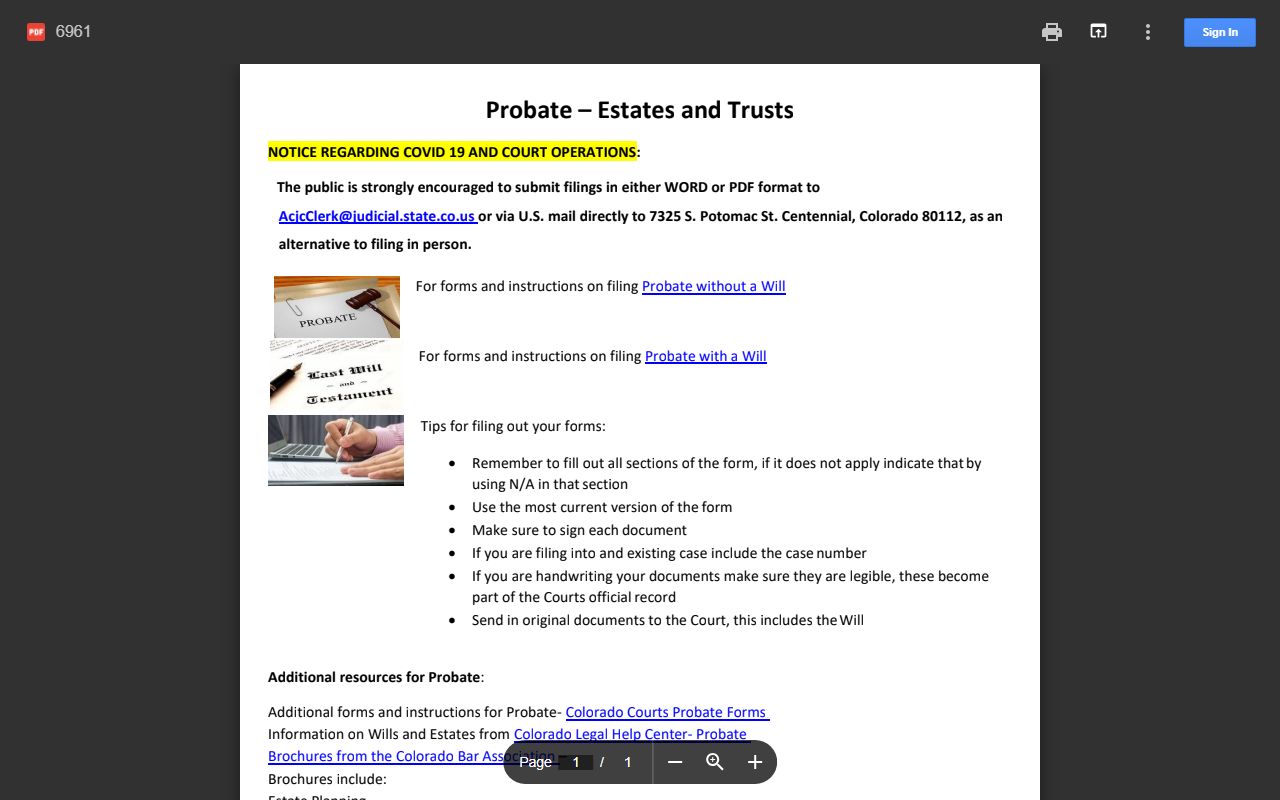
The document is the official starting point for understanding how Arapahoe District Court processes wills, estate applications, guardianships, and conservatorships.
Types of Probate Administration in Arapahoe County
Colorado law provides several ways to handle a decedent's estate depending on the size of the estate, the complexity of the assets, and whether anyone is likely to contest the proceedings. Choosing the right type matters because it affects how much court involvement is required and how long the process takes.
Informal probate is the most common path for straightforward estates. The personal representative files an application without a formal court hearing, and the court appoints them through a registrar rather than a judge. The personal representative then administers the estate with limited court supervision, filing a closing statement when complete. This process is faster and less expensive than formal probate.
Formal probate requires a court hearing before a judge. It is used when the will may be contested, when interested parties object to the appointment of the personal representative, or when the circumstances require judicial oversight. A judge issues an order determining who has a valid claim, confirming the will, or resolving disputes about the estate.
Supervised administration is the most intensive form. The court supervises every major step from inventory to final distribution. It is typically ordered when there is a history of disputes, when creditors or heirs request it, or when the court finds that oversight is necessary to protect interests.
Small estate affidavit (collection by affidavit) is not a full probate proceeding. Under Colorado law, an heir may be able to collect certain personal property without opening a probate case if the gross value of the personal property does not exceed the statutory threshold. The key statute is C.R.S. § 15-12-1201. The threshold amount should be verified against the current Colorado Judicial Branch forms before relying on a specific dollar figure, as the amount is subject to legislative adjustment. If the estate qualifies, the heir signs a sworn affidavit stating the relevant facts, and no court case needs to be opened for that personal property.
Note: Real estate cannot generally be transferred by small estate affidavit alone; a probate case or other legal mechanism is usually required for real property.
Guardianship and Conservatorship in Arapahoe District Court
Guardianship and conservatorship proceedings protect people who cannot manage their own affairs. Both case types are filed in Arapahoe District Court and proceed under Title 15 of the Colorado Revised Statutes. They are related but cover different responsibilities.
A guardianship gives the appointed person the right to make personal decisions for the ward, such as where the ward lives, what medical care they receive, and how they spend their time. A conservatorship gives the appointed person control over the ward's finances and property, including paying bills, managing investments, and filing taxes. Courts may appoint a guardian only, a conservator only, or both, depending on what the ward needs.
Petitions for adult guardianship and conservatorship are filed when a person has become incapacitated due to age, illness, injury, or disability. Petitions for minor guardianship arise when a child's parents are unable to care for them and no other legal arrangement is in place. The court sets a hearing, notifies the person who would become the ward, and appoints a visitor or investigator to report on the ward's situation. A judge then decides whether to grant the petition.
Once appointed, guardians and conservators must file regular reports with the court. Conservators submit accountings showing income, expenses, and asset balances. Guardians file status reports on the ward's condition and living situation. These filings become part of the public probate case file, though some medical and financial details may be restricted from public view.
Forms for guardianship and conservatorship cases are available through the Colorado Judicial Branch self-help forms library under the Guardians and Conservators category. The Family Court Facilitator at the Arapahoe Justice Center, Karla Carrigan (303-645-6853), can help self-represented parties understand the process and complete forms correctly.
Filing a Will for Safekeeping at Arapahoe District Court
Colorado allows a person to deposit their will with the District Court in the county where they reside for safekeeping during their lifetime. Arapahoe District Court accepts wills for deposit under Colorado Judicial Branch rules. The will is sealed and held by the Clerk of Court until the testator dies or requests its return.
Depositing a will for safekeeping does not open a probate case. It simply ensures the original document is preserved and available when needed. After the testator's death, the person who has custody of the will or who finds it has a duty under Colorado law to file it with the appropriate court. If the will was already on deposit at Arapahoe District Court, it will be there when the estate needs to be opened.
To deposit a will for safekeeping, contact the Arapahoe Court Records team at 303-645-3814 or 18records@judicial.state.co.us for current procedures and any applicable fee. The court is located at 7325 S. Potomac St., Centennial, CO 80112, open Monday through Friday, 7:30 a.m. to 4:30 p.m.
Probate Record Copy Fees in Arapahoe County
The Arapahoe Court Records Request Form sets out the fee schedule for copies of court documents, including probate filings. These fees apply to estate cases, guardianship and conservatorship files, and other probate-related records maintained by the Arapahoe District Court.
| Item | Amount |
|---|---|
| Plain copy (per page) | $0.25 |
| Certified copy | $20.00 |
| Certification fee | $20.00 |
A certified copy is a copy of a court document that the Clerk of Court stamps and signs to confirm it is a true and accurate reproduction of the original. Banks, title companies, and other institutions generally require a certified copy rather than a plain copy when relying on a probate order or letters testamentary. Submit your records request by email to 18records@judicial.state.co.us or by mail to Arapahoe Court, Attn: Records Requests, 7325 S. Potomac St., Centennial, CO 80112. The records team responds within three business days.
Filing fees for opening an original probate case or guardianship petition are set by the Colorado Judicial Branch and are not listed in the records request form. Verify current filing fees through the Colorado Judicial Branch fee schedule or by calling the Arapahoe Clerk of Court at 303-645-6600 before filing. The self-help forms library also links to current fee information for probate and guardianship filings.
What Arapahoe County Probate Records Contain
A probate case file in Arapahoe District Court can be substantial. The types of documents that typically appear in an estate or guardianship file include the following.
| Document or Field | What It Shows |
|---|---|
| Application or petition | Initial filing stating the decedent's or ward's information, the requested action, and the petitioner's relationship to the matter |
| Will or codicil | The testator's written instructions for distributing assets; the original or a certified copy is filed with the court |
| Letters testamentary or letters of administration | Court-issued document authorizing the personal representative to act on behalf of the estate |
| Notice to creditors, heirs, and devisees | Published or mailed notice giving parties the right to file claims or contest the proceedings |
| Inventory | List of the decedent's assets and their estimated values at the time of death |
| Accounting | Financial report showing income received, expenses paid, and assets remaining; filed by the personal representative or conservator |
| Orders and decrees | Judge's written decisions on contested matters, approval of accountings, discharge of personal representative, and final distribution |
| Closing statement or decree of final distribution | Document that closes the estate and confirms property has been distributed to heirs and devisees |
| Guardianship and conservatorship reports | Annual status reports and accountings filed by guardians and conservators; some personal and medical details may be restricted |
The docket entry for each Arapahoe County probate case shows the case number, the case type, the parties, the filing dates, and a log of every document filed and every hearing held. Case numbers for probate matters typically include the year and a probate-class identifier. If you are searching for a specific estate, searching by the decedent's name in the authorized vendor portal or through the docket search is the fastest way to confirm a case was filed.
How Probate Works in Arapahoe County
Arapahoe County estate cases follow a general sequence set by the Colorado Probate Code. The steps below describe the informal probate path, which is the most common route for straightforward estates. Formal and supervised proceedings involve additional hearings and filings at each stage.
- Determine whether probate is needed. Not every death triggers a full probate case. Small estates may qualify for collection by affidavit under C.R.S. § 15-12-1201. Assets held in joint tenancy, payable-on-death accounts, or living trusts pass outside probate. Review the estate's assets before filing anything.
- File the application in Arapahoe District Court. If the decedent lived in Arapahoe County or owned property there, file the application or petition at the Justice Center, 7325 S. Potomac St., Centennial, CO 80112. Bring the original will if one exists, a death certificate or proof of death, and the completed forms from the Colorado Judicial Branch self-help forms library.
- Receive appointment as personal representative. In an informal case, the registrar reviews the application and issues letters testamentary or letters of administration without a hearing. In a formal case, a judge holds a hearing and issues an order appointing the personal representative.
- Give notice to creditors, heirs, and devisees. The personal representative must publish notice to creditors and mail notice to known heirs and devisees. Creditors have a limited time to file claims against the estate. This step is required even in informal proceedings.
- Inventory and manage assets. The personal representative prepares an inventory of the decedent's assets and their fair market values. They collect debts owed to the estate, manage investments, maintain property, and keep accounts of all transactions.
- Pay valid creditor claims, debts, and taxes. Creditor claims are reviewed and paid in the order set by Colorado law. Federal and state estate taxes, if owed, are paid before distribution to heirs. The personal representative can object to claims they believe are invalid.
- Distribute remaining property to heirs and devisees. After creditors and taxes are paid, the personal representative distributes the remaining assets according to the will or, if intestate, according to Colorado's succession statutes in Title 15.
- Close the estate. The personal representative files a closing statement with the court. In a supervised proceeding, the court issues a final decree of distribution. The case is then closed and the personal representative is discharged from further liability.
Contested wills, disputed claims, and cases with complex assets can take significantly longer. The court may set multiple hearings, order mediation, and issue rulings on each disputed issue before the estate can be closed. The Office of Dispute Resolution, linked from the Arapahoe court page, can assist parties in reaching agreement outside of full litigation.
Restricted Arapahoe County Probate Records
Most probate case files are public records, but certain portions of a file may be restricted from public access. Guardianship and conservatorship cases often contain medical evaluations, psychological assessments, and detailed financial records that identify sensitive personal information. Courts may seal specific documents or portions of documents to protect the ward's privacy while keeping the general case index open to the public.
Mental health and incapacity proceedings filed as part of a guardianship action may have additional statutory protections. Adoption-related matters that arise in connection with a minor guardianship are typically confidential. If a probate matter involves a minor, records containing the child's full name, address, or identifying information may be restricted under the Colorado Children's Code and the Judicial Branch's access policies, including Chief Justice Directive 05-01.
If your records request is partially denied, the court will tell you which documents or portions are restricted and under what authority. You may be able to petition the court for access if you have a legal right to the information, such as being a named party or personal representative in the case.
Self-Help Resources for Arapahoe County Probate
The Colorado Judicial Branch maintains a full set of probate, guardianship, and conservatorship forms through its self-help forms library. All forms are officially approved and updated as statutes change. Using outdated forms is a common reason for rejection at the counter, so download forms from the official source rather than saving copies for later reuse.
The Arapahoe County court page links a dedicated self-help resources page for the 18th Judicial District. It covers probate court, guardianship, conservatorship, and family law topics, with links to current forms and instructions. The statewide Colorado Judicial self-help resources page covers all case types statewide and connects users to the Colorado Legal Help Center for civil legal information.
The official forms library at coloradojudicial.gov/self-help-forms organizes probate forms by category, including Trusts/Estates/Wills and Guardians/Conservators. Each category includes the petition or application, required notices, inventory forms, accounting forms, and closing documents. The forms come with instructions and, in some cases, court-approved cover sheets.
The Family Court Facilitator, Karla Carrigan (303-645-6853), assists self-represented parties at the Arapahoe Justice Center with procedural questions, form completion, and navigating the steps of a guardianship or conservatorship case. The Facilitator does not give legal advice and cannot represent you in court, but can help you understand what documents to file and when.
The Colorado Legal Help Center, linked from the Judicial Branch self-help page, connects people with civil legal information and referrals, including resources for estate planning, probate, and elder law. The Office of Dispute Resolution, accessible through the Arapahoe court quick links, can help parties in disputed probate matters explore mediation before a contested hearing.
The Colorado Judicial Branch self-help forms library provides official probate, guardianship, and conservatorship forms for use in Arapahoe District Court and all other Colorado District Courts.
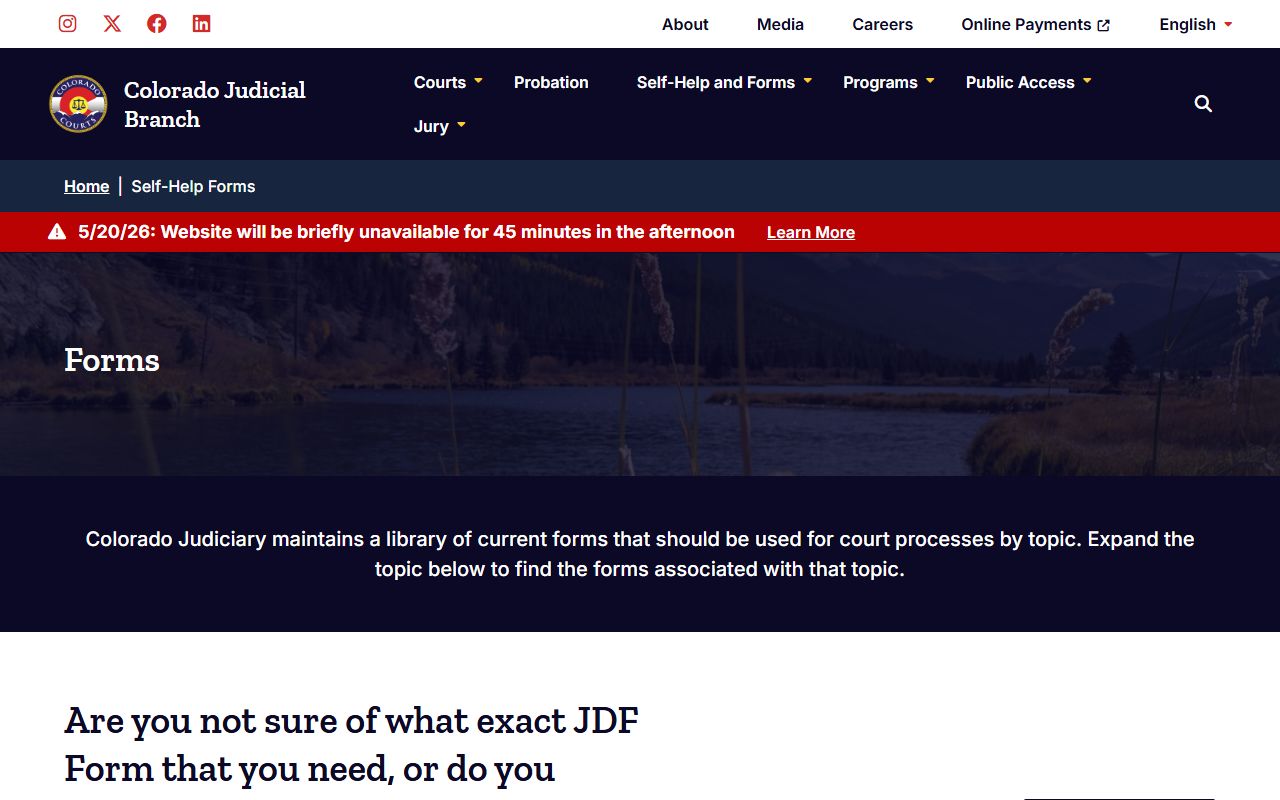
Forms for estates, wills, guardianships, and conservatorships are organized by category and updated when Colorado probate statutes change, making this library the correct source for current Arapahoe County probate filings.
Common Probate Timelines in Arapahoe County
How long a probate case takes depends on the type of administration selected, the size and complexity of the estate, and whether anyone contests the proceedings. Small estate affidavit cases have no court filing and can be resolved in days. Informal probate cases for simple estates can close in as little as six months, which is roughly the minimum time needed to complete the creditor notice period, collect assets, pay debts, and file a closing statement. More complex estates commonly take one to two years.
Formal and supervised probate cases almost always take longer because every major step requires court approval. Contested cases involving disputed wills, missing heirs, or allegations of mismanagement by the personal representative can extend the timeline to three years or more. Guardianship and conservatorship cases do not close on a fixed schedule; they remain open as long as the ward is alive and requires protection, with annual reporting requirements throughout.
The Arapahoe Court Records team responds to records requests within three business days. If you need a certified copy of a probate order for a real estate closing or other time-sensitive purpose, submit the request as early as possible and note any deadline in your email or letter.